
A practical reference for matching GDT implants to the right prosthetic components — before you place the order.
Ordering the wrong abutment costs you a delayed case, an irritated patient, and a return shipment. The good news is that GDT's system is logical once you know the three questions that determine compatibility.
This guide walks through them in order. Work top to bottom and you'll land on the right component every time.
Question 1: What connection does the implant have?
This is the first fork in the road, and everything downstream depends on it. GDT implants fall into three groups.
Internal Hex implants

The largest family in the GDT line. If you're placing any of these, you're in the internal hex world:
| Family | Description | Diameters |
|---|---|---|
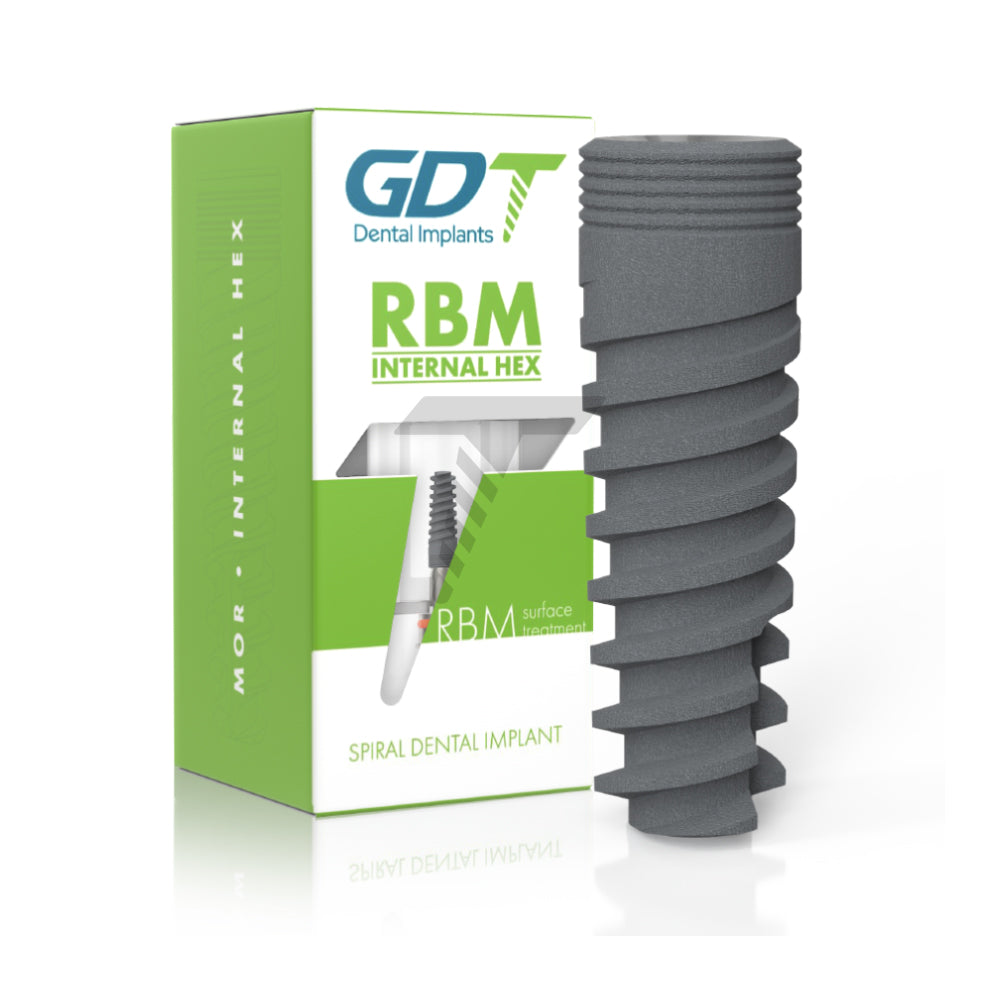
| RBM | Spiral implant, internal hex | 3.0 Slim – 5.0 mm |
| MOR | Spiral implant, internal hex | 3.5 – 6.0 mm |
| ABA | Spiral implant, internal hex | 3.5 – 6.0 mm |
| CFI | Spiral implant, internal hex | 3.5 – 6.0 mm |
| EVA | Spiral implant, internal hex | 3.0 Slim – 5.0 mm |
| MAX | Basal / cortical, internal hex | 4.2 – 6.0 mm |
| PTR | Pterygoid, internal hex | 4.2 mm |
| ZYG | Zygomatic | 4.2 mm |
All of these accept Internal Hex prosthetic components.
Conical Connection implants

A separate connection geometry with two platforms — and this is where most ordering mistakes happen:
| Platform | Abbreviation | Implant diameters |
|---|---|---|
| Narrow Platform | NP | Ø3.5 mm |
| Regular Platform | RP | Ø4.3 mm and Ø5.0 mm |
NP components do not fit RP implants, and vice versa. The platform is not the same thing as the implant diameter — Ø4.3 and Ø5.0 are different diameters that share the same RP platform.
One-piece implants

OPI, OPIB, ROT and ROF have the abutment machined as part of the implant body. There is no connection to match and no abutment to order — you prepare and restore the integrated post directly.
The exception: for impressions on root-shaped one-piece implants, use the dedicated Impression Coping Transfer for Root Shaped One-Piece Implant.
Question 2: What restoration are you planning?
Once you know the connection, the restorative plan narrows the component.
Single crown, cement-retained
Order a straight or angulated abutment in the matching connection. Angulated anatomic snap-on transfer abutments are available at 15° and 25°, in 1–4 mm gingival heights.
Single crown, digital workflow
Order a titanium base (Ti-Base). Two things to specify:
Connection. Conical Connection Ti-Bases come in Narrow or Regular Platform. Internal Hex Ti-Bases come in a wider range of profiles: Anti-Rotational, Rotational, Angulated Anti-Rotational, Angulated Rotational, Slim Anti-Rotational and Slim Rotational, in heights 0.5 / 1 / 2 / 3 / 4 mm.
Rotation. Anti-rotational for single units (the crown must not spin). Rotational for splinted or multi-unit restorations, where the rotational lock would prevent passive seating.
Pair it with the matching scan body for your intraoral scanner.
Full-arch and multi-unit

Multi-Unit abutments come in two screw systems, and they are not interchangeable:
| System | Available angles | Notes |
|---|---|---|
| Multi Unit 1.4 | Straight, 17°, 30°, 45°, 52°, 60° | Also available in Slim Platform |
| Multi Unit 1.6 | Straight, 17°, 30°, 45° | Also available in Slim Platform (17° / 30°) |
⚠️ The screw is system-specific. A MULink Screw for Multi Unit 1.4 will not work on a 1.6 abutment, and the reverse is equally true. When you reorder screws, check which system is already in the patient's mouth.
Sleeves follow the same rule — titanium sleeves for definitive restorations, plastic sleeves for castable work, each in 1.4 or 1.6 to match the abutment.

Zygomatic cases

Zygomatic implants (Ø4.2 mm, 30–60 mm lengths) are restored through the Multi Unit 1.4 system — angulated abutment, analog and sleeve. Plan the angulation with the prosthetic path in mind before surgery.
Question 3: What healing protocol?
Healing caps are selected by platform width, not by implant diameter:
- Concave Anatomic Healing Cap Ø5.5 — Wide Platform
- Concave Anatomic Healing Cap Ø6.3 — Extra Wide Platform
Both come in 2–6 mm heights. Choose the height that clears the soft tissue without over-contouring the emergence profile.
The drivers
A detail that catches people out: implants and prosthetics use different driver sizes.
- Implant driver: 2.42 mm
- Prosthetic driver: 1.25 mm
The GDT Hex Driver with Built-in Light covers both.
Quick reference
| If you placed… | You need… |
|---|---|
| RBM / MOR / ABA / CFI / EVA / MAX / PTR / ZYG | Internal Hex components |
| Conical Ø3.5 | NP (Narrow Platform) components |
| Conical Ø4.3 or Ø5.0 | RP (Regular Platform) components |
| OPI / OPIB / ROT / ROF | No abutment — restore the integrated post |
| Single unit, digital | Anti-rotational Ti-Base + scan body |
| Splinted / multi-unit | Rotational Ti-Base, or Multi-Unit abutments |
| Full arch | Multi Unit 1.4 or 1.6 — match the screw system |
Three mistakes worth avoiding
1. Assuming diameter equals platform. Ø4.3 and Ø5.0 conical implants share the RP platform. Ordering by diameter alone will eventually bite you.
2. Mixing 1.4 and 1.6 Multi-Unit parts. They look similar and they do not interchange. Record which system you used in the patient's chart at surgery — your future self will thank you at the restorative appointment.
3. Choosing anti-rotational for a splinted case. The rotational lock that protects a single crown will fight you when seating a multi-unit framework.
Still unsure?
If you have the implant on hand but aren't certain which components you need, send us the implant reference and we'll confirm it before you order. We'd rather spend two minutes on the phone than have you receive the wrong part.
BB Dental Supply — authorized GDT Dental Implants distributor, Miami, Florida.
Email: info@bbdentalsupply.com
Phone: 786-327-7864
Browse GDT Dental Implants and GDT Prosthetics & Abutments.
This guide is intended for licensed dental professionals. Always confirm component compatibility against the manufacturer's current instructions for use (IFU) before clinical use.