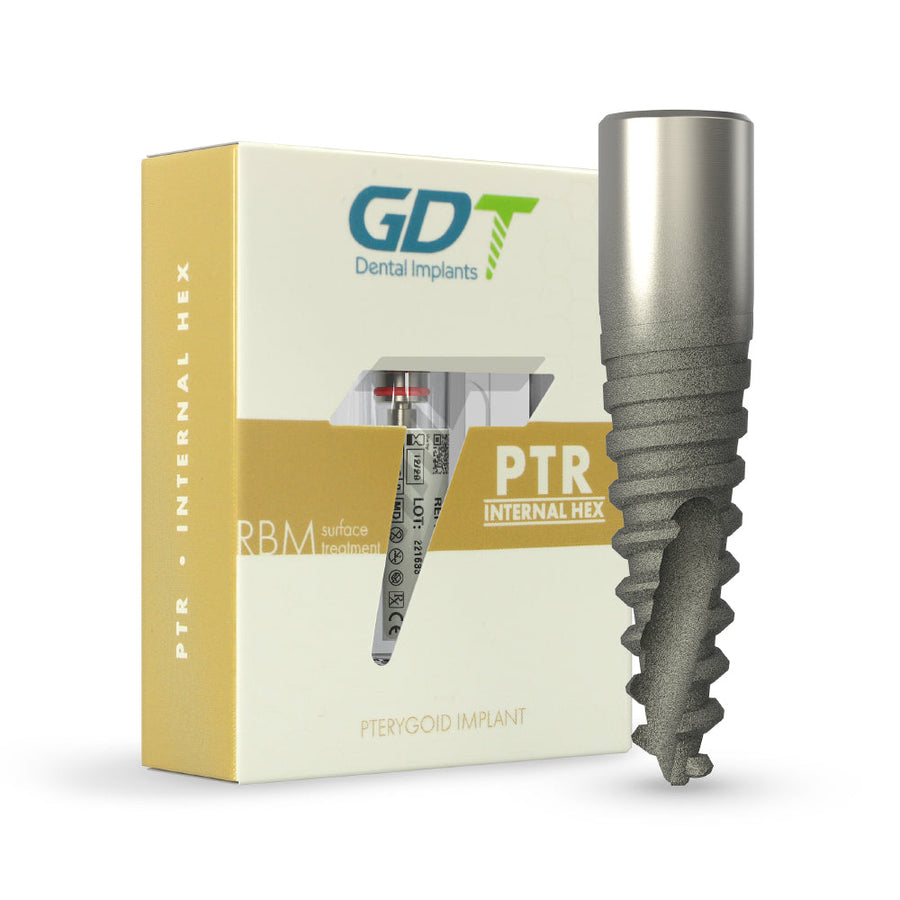
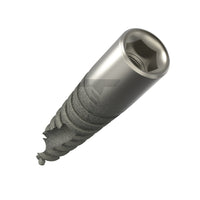
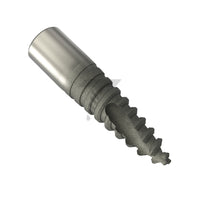
PTR - Pterygoid Implant, Internal Hex
# Connection: Internal Hex 2.42mm
# Implant Diameters: Ø4.2mm
# Implant Length: 18.0mm, 20.0mm, 22.5mm, 25.0mm
# Condition: Sterilized, Double Packaging
# Material: Titanium grade 5 (TI-6AL-4V ELI)
# Surface Treatment: RBM - Resorbable Blast Media, Calcium Phosphate.
# Country of Manufacture: Israel.
GDT PTR is a bone level Pterygoid Implant designed for use in the posterior maxilla and pterygomaxillary regions, where conventional implant placement is limited due to poor bone quality or sinus proximity. Its geometry is suited for cases requiring extended anchorage, such as restoration of the atrophic maxilla or full-arch rehabilitations.
This implant is manufactured from titanium grade 5 (Ti-6Al-4V ELI) and features a self-tapping body with a dual-thread design. The apical section features sharp threads that cut through dense cortical bone, while the middle section is shaped to compress trabecular bone, enhancing initial stability and load distribution. The coronal section includes a smooth, polished collar designed to minimize bacterial accumulation and support soft tissue health by reducing mechanical irritation at the crest.
For optimal results in PTR implant placement, we advise utilizing our Surgical Kit designed specifically for Basal/Cortical Implants.
GDT implants are made of Titanium alloy Ti-6Al-4V ELI. This material combines properties such as low specific weight, high strength to weight ratio, very high corrosion resistance, and excellent general biocompatibility.
Ti-6Al-4V ELI is very similar to Ti-6Al-4V, except that Ti-6Al-4V ELI contains reduced levels of oxygen, nitrogen, carbon, and iron. ELI is short for “Extra Low Interstitials”, and these lower interstitials provide improved ductility and better fracture toughness for the material.
Ti-6Al-4V ELI has proven to be highly successful in the fabrication of dental implants
Surface Treatment:
RBM surface is rough and hydrophilic.
This surface treatment is designed to roughen the implant surface without leaving the residual embedded blast particles or debris in the treated substrate.
To gain the desired roughening the implant is blasted with suitable hardened particles of Hydroxyapatite (beta-tricalcium Phosphate, Alpha Tcp, TTcp, and Calcium Phosphate (CPP) and then subsequently dissolved from the surface with a defined passivation treatment.
Surface roughness between Ra 1.2 - 1.5 is consistently achieved.
The result is a rougher implant surface than traditional acid etches treatment providing a greater surface area for osseointegration, improved retention characteristics, increased biological fixation, and maximizing implant-to-bone contact.
The shape of the implant is made for simple and secure work and improving the osseointegration level.
The RBM surface treatment is made to improve the healing process and tissue growth around the implant, with no worries of abruption or disintegration.

More from this category